We drove to Tartu this morning. In the assembly hall of the Estonian University of Life Sciences StartSun came to an end: a three-year Interreg Baltic Sea Region project that got five different kinds of energy community running in five countries. Two things were launched at the finish: a start-up package for anyone who wants to found a community, and a calculator that tells you whether it pays off at all.
16 ha
the supply area of the Sylvia substation in Assaku, where the Rätsepa solar park sits. The natural border of an energy community is not a village or a municipality. It is one transformer and the houses hanging off it.
We did not go there to learn what an energy community is. By law it is a legal entity whose members produce, consume, store and share electricity together, and whose purpose is not, first and foremost, a return on investment. We knew that. We went because we have something like that half-built in Assaku, and we wanted to know what had not worked out for the others.
Eight members, 400 kW and one grid
Tobias Karlsson from Sweden opened the day with a village where eight members built themselves a 400 kW energy system behind a single grid connection. Eight. Not eighty. That number stayed in my ear all day, because our substation area in Assaku has 70 to 80 houses and I had assumed a community had to be big.
Then came six pilots in a row: Obinitsa and Kääpa from Estonia, Jelgava and Jēkabpils from Latvia, Marttila from Finland, Östergötland from Sweden. In Obinitsa, in Setomaa, the cooperative Oma Elekter was founded in October 2024 and put panels and a 60 kW battery on its roof this March. Markus Männik's line: our own electricity gives the cooperative the confidence to act. In Kääpa, Annika Oras is registering an energy community under the Kalevipoja Koda foundation, even though local businesses have not shown interest yet.
The afternoon was the social side, and it was honest. Maie Kiisel from the University of Tartu talked about what breaks for initiators, and Xavier Simón used Galicia to show what drives or stalls a rural community. Nele Ivask of TREA had already named three barriers and three preconditions in the spring. Barriers: grid connection is complicated, energy sharing is restricted, the initial investment has to come from somewhere. Preconditions: a concrete need, an active core group, and partners, including the municipality and a local business. Every pilot story I heard today was written around those six points.
An energy community is not economically viable, because margins, fees, excise and taxes rule out any payback
StartSun is a necessary project, but unfortunately it focuses only on activating joint action in communities.
The fundamental problem is political in every country: whether a community is allowed to run its own electricity behind the substation connection in a way that gives the grid operator (Elektrilevi) no profit and the state no taxes.
A calculator hidden inside an Excel file
At four o'clock Marten Saareoks of TREA presented the StartSun calculator. It is a free Excel file. Four steps: monthly consumption and your electricity price, the location, size and orientation of the solar plant, financing with a loan or a grant, and finally a short questionnaire about the community. Out comes production, self-consumption, savings, payback time and the three best-fitting community types out of twelve.
I downloaded it during the conference and took it apart. The visible sheets are a pure form, zero formulas. All the logic lives on eight hidden sheets, close to 4,900 formulas, plus macros that pull hourly production from the European Commission's PVGIS database. The macros only run on Windows. On a Mac the file does not run at all.
It is a good tool in bad packaging. So we are building a web version. The engine is done and tested, and the PVGIS request goes through our own server. One thing we found straight away: the Excel uses hourly data from 2023, and 2023 was a sunny year in Estonia. For Tallinn that gives 1,145 kWh per kilowatt, while the long-term average is about 4% lower. The web version will say so to the reader. The Excel does not.
Rätsepa: what we already have
The Rätsepa plot is in Assaku, 2.2 ha, right next to Rätsepa road. It holds a solar park with 352 panels, 112.6 kWp, two Huawei inverters, two grid connections of 3×63 A each, and a bidirectional meter at the property line.
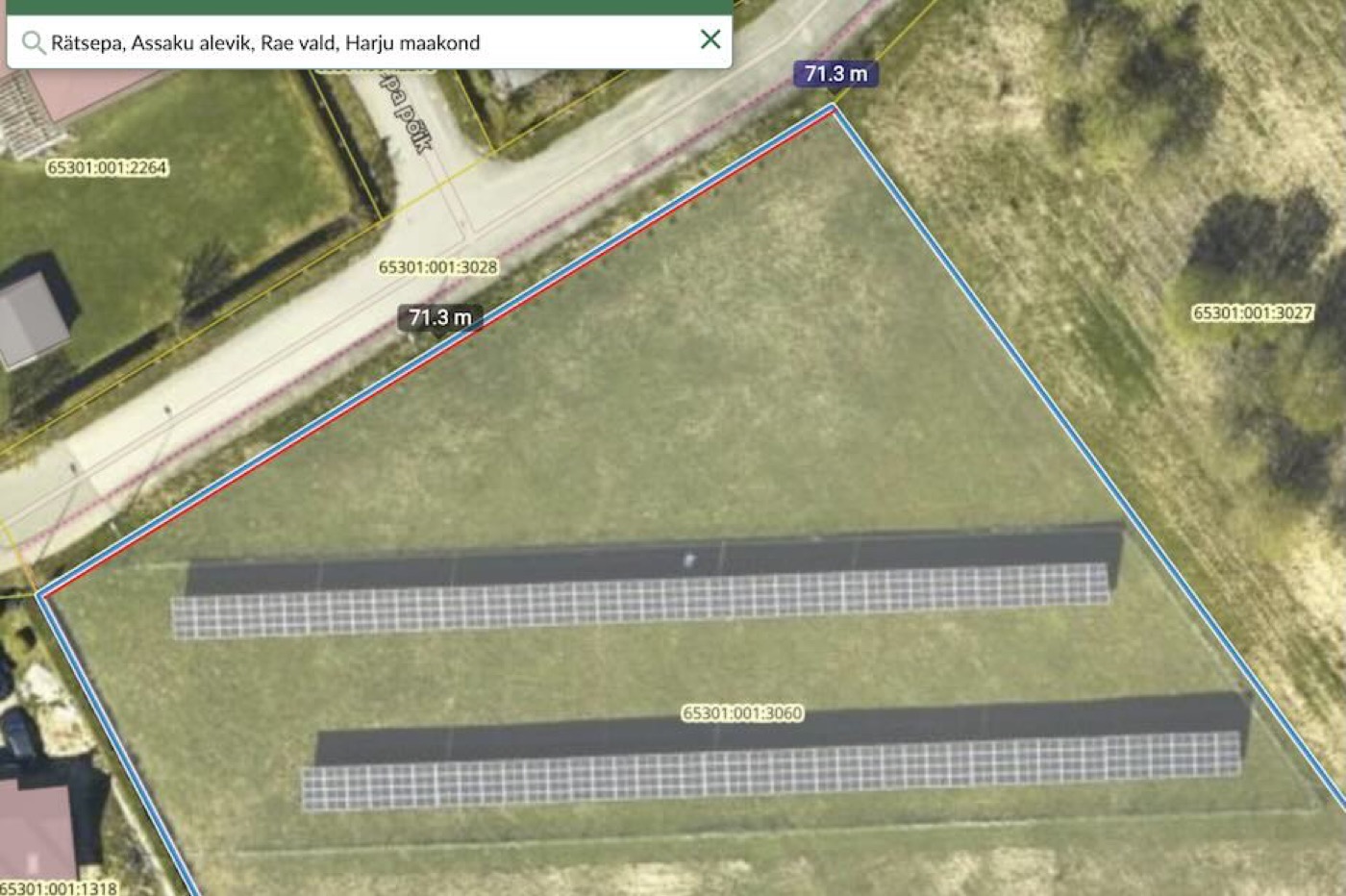
Right now the park sells its surplus to the grid. That is the simplest and the worst thing you can do with a solar park. Fortunately, Volton offers a way into the frequency and capacity markets.
In August I sent TREA the Elektrilevi map that shows which houses hang off the Sylvia substation. The red polygon is the supply area, roughly 16 ha and 70 to 80 homes. The purple lines are low-voltage lines. The green circle is our park.
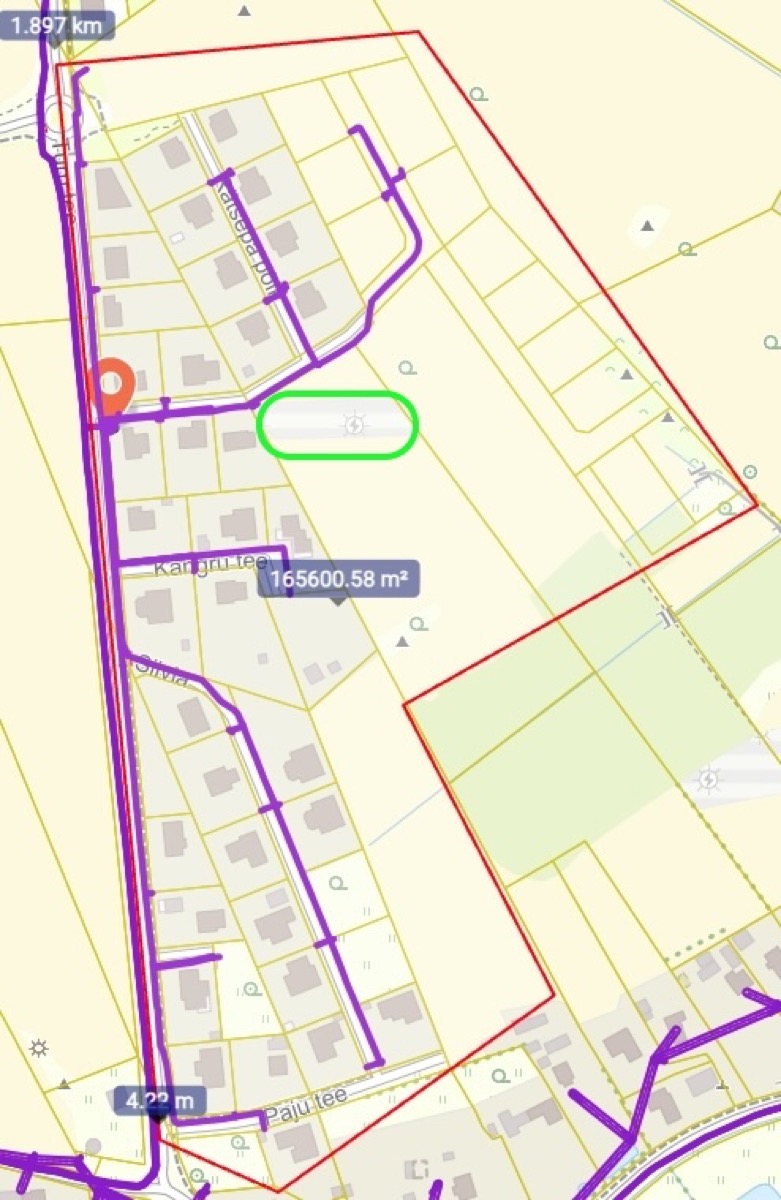
About ten of those houses have their own panels and six have an EV charger. Which means the core group exists before anyone has said the word community.
The diagram I drew before the conference
I put the idea on one picture so TREA and I would have something to talk about.
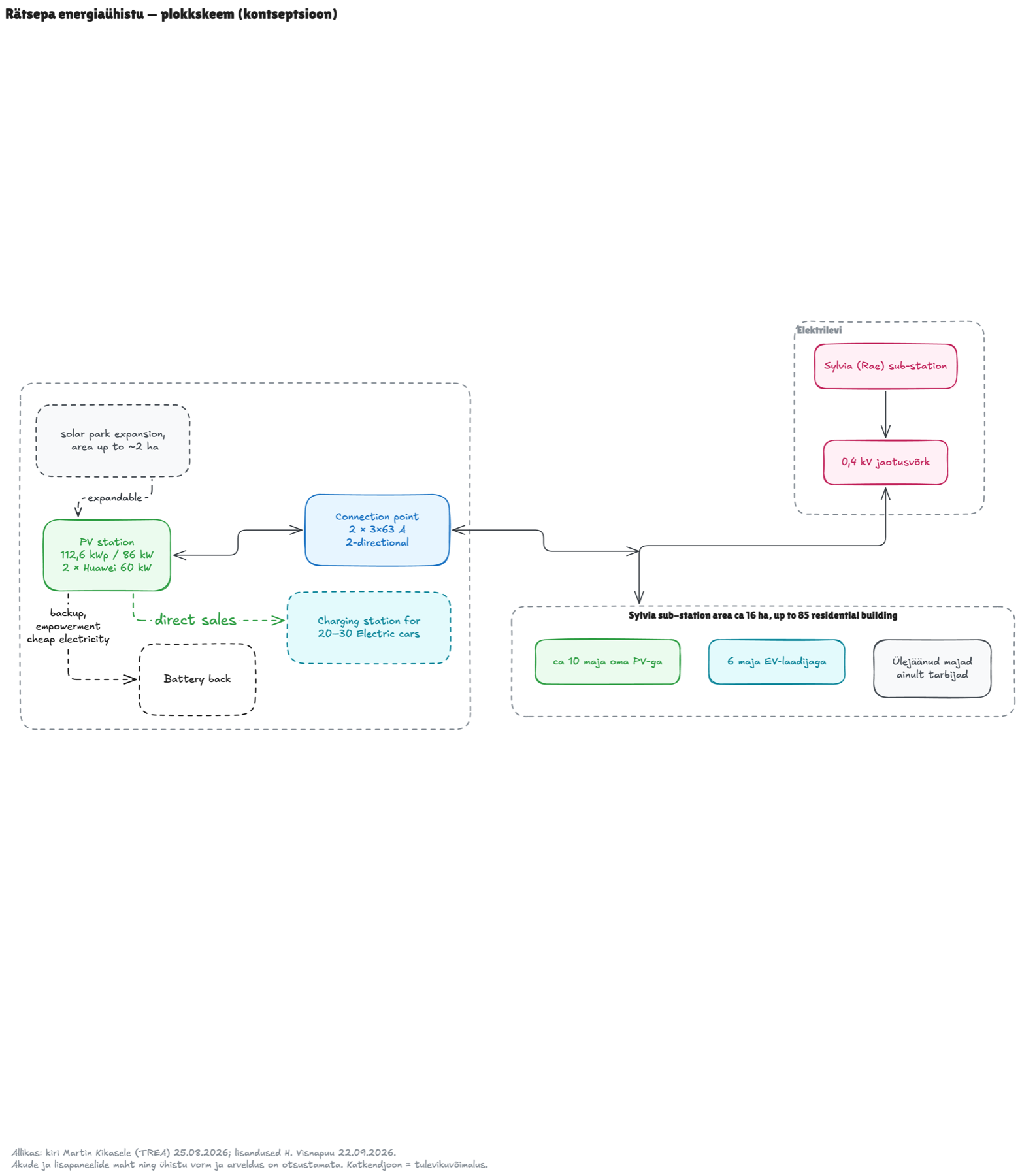
On the left is Rätsepa: the existing park, a dashed expansion of up to 2 ha, a battery bank and a charging park for 20 to 30 electric cars along Rätsepa road. On the right is the Elektrilevi substation and the distribution grid. At the bottom are the members: houses with their own panels, houses with a charger, and the rest who only consume.
The green arrows are our own production: from the park into the battery and from the park into the charging park, without touching the grid. The blue line from the connection point to the members is the one whose form is open.
Does billing run through Elektrilevi, or between the members themselves?
Elektrilevi offers a billing service. The question is whether the members' electricity purchases and sales are settled through the grid operator, or whether we only get the meter data from them and the money moves between the members on its own.
Three things on the diagram are deliberately blank.
- Battery capacity
- The size of the expansion
- Who builds the charging park, an operator with their own money or us
Each is a separate decision and none of them has been made.
What you do differently now
If you have panels on a roof or in a field and you are thinking about a community, do not start with the law. Open the Elektrilevi map, find your substation and count the houses in its supply area. That is your community. Everything else, the articles of association, billing, the form of sharing, comes after.
And if you want to run the numbers first, the StartSun calculator exists. On a Windows machine. I will post here when the web version is ready.